Shunyu Wu
  • Home
  • News
  • Research
  • Publications
  • Projects
  • Thinking
  • Service
  • Contact
  • Scholar
  • ORCID
  • GitHub

Shunyu Wu (吴舜禹)

Physical intelligence through dynamics and decisions

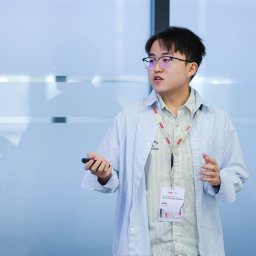
Portrait of Shunyu Wu

Shunyu Wu

吴舜禹

Ezra Systems Postdoctoral Associate

Systems Engineering
Cornell University
Ithaca, New York

  • shunyu.wu@cornell.edu
  • Google Scholar
  • ORCID
  • GitHub
  • ResearchGate

About

I am an Ezra Systems Postdoctoral Associate in Systems Engineering at Cornell University, where I work with Professor Fengqi You. I completed my Ph.D. at Shanghai Jiao Tong University in 2026, advised by Professor Jingcheng Wang.

Physical intelligence is the ability of a learning system to model a physical system and to act on it. Both modeling and control depend on the system's dynamics. I train neural networks to solve the equations describing these dynamics fast enough for repeated control and optimization. I then measure how errors in these solutions affect the resulting decisions.

My current materials research focuses on initiated chemical vapor deposition (iCVD) coupled with liquid crystals (LC). Chemical formation coupled with LC is a possible extension. My engineering work at Shanghai Jiao Tong University covered power generation, urban water supply, and hot-strip rolling.

Research

trains and evaluates the solver 1 The governing equations describe how a system changes. iCVD with liquid crystals · power generation · water supply · hot-strip rolling 2 Each control or optimization step requires solving these equations again. 3 A neural solver learns the solution map and returns a solution in one pass. 4 Each learned solution contains an error. 5 The error changes the decision slightly in most regimes and substantially near a critical point. 6 Training and evaluation use decision error rather than field error.
  • A. Physical dynamics, step 1
  • B. Neural solvers, steps 2 and 3
  • C. Model2Action, steps 4 to 6
The six steps connect physical dynamics to solver training. Decision error provides feedback from step 6 to step 3.
  • A. Physical dynamics in science and engineering. Science: iCVD coupled with liquid crystals, with Professor Fengqi You. Engineering: power generation, urban water supply, and hot-strip rolling, from my Ph.D. with Professor Jingcheng Wang.
  • B. Neural solvers for physical dynamics. A neural operator approximates the solution map of a governing model and returns a solution in one forward pass. I train it so that its rollouts and sensitivities are accurate enough for control and optimization.
  • C. Model2Action. The error in a learned solution changes the decision slightly in most operating regimes and substantially near a critical point or an active constraint. I measure the decision error as regret, closed-loop cost, and constraint violation, and I use it to train the solver.

The full research program

News

  1. Aug 2026
    Joined Cornell University as an Ezra Systems Postdoctoral Associate! I work with Professor Fengqi You on physical intelligence for materials processing.
  2. Aug 2026
    Invited to review for ICLR 2027!
  3. Jul 2026
    DRIFT appeared in Expert Systems with Applications.
  4. Jun 2026
    Received my Ph.D. from Shanghai Jiao Tong University! I thank my advisor, Professor Jingcheng Wang, and my labmates for six good years.
  5. 2025
    SPTO appeared in IEEE Transactions on Smart Grid.

All news

Selected publications

  1. DRIFT visual abstract showing LiDAR graph memory and target-directed diffusion

    DRIFT: Coordinating target intent and local geometry for diffusion-based trajectory generation

    Jinyang Zhao, Handong Zheng, Yanjiu Zhong, Qiang Zhang, and Shunyu Wu

    Expert Systems with Applications, 2026 Last author C

    A graph memory stores local LiDAR geometry and provides waypoint-specific context at each step of recurrent diffusion denoising.

  2. SPTO visual abstract linking a forecast distribution, a differentiable optimality-gap surrogate, and a stochastic schedule

    End-to-End Stochastic Predict-Then-Optimize for Cost-Efficient Water-Energy Resource Scheduling

    Shunyu Wu, Jingcheng Wang, Haotian Xu, Yanjiu Zhong, and Jun Rao

    IEEE Transactions on Smart Grid, 2025 First author A C

    The training objective for the forecasting model includes scheduling cost through a differentiable upper bound on the optimality gap.

  3. Bi-correction model visual abstract showing lag-penalty attention and posterior error correction

    Knowledge-based Bi-correction model for achieving effective lag-free characteristic on daily urban water demand forecasting

    Shunyu Wu, Jingcheng Wang, Haotian Xu, Shangwei Zhao, and Jiahui Xu

    Expert Systems with Applications, 2024 First author A B

    Lag-penalty attention and posterior residual correction reduce the delayed response of a learned demand model near turning points.

  4. CritiCoder visual abstract separating measured effects from unobserved disturbances

    CritiCoder: An End-to-End Uncertain Regression Network for Robust Macroscopic Pressure Models in Water Distribution Systems

    Shunyu Wu, Jingcheng Wang, Haotian Xu, Shangwei Zhao, and Jiahui Xu

    IEEE Transactions on Computational Social Systems, 2024 First author A B

    The Coder models the pressure response to measured inputs. The Critic models the residual variation caused by unmeasured disturbances.

  5. Constrained reinforcement learning controller visual abstract

    Reinforcement Learning Controller Design for Discrete-Time-Constrained Nonlinear Systems With Weight Initialization Method

    Jiahui Xu, Jingcheng Wang, Yanjiu Zhong, Jun Rao, and Shunyu Wu

    IEEE Transactions on Systems, Man, and Cybernetics: Systems, 2024 Last author C

    Nonlinear model predictive control initializes the controller weights. A control barrier function with a nonquadratic loss enforces the state and input constraints during learning.

All publications by year

Academic service

I review for ICLR in the 2025 and 2026 cycles and have been invited for 2027. I have also reviewed for ICML, NeurIPS, AAAI, and CDC, and for four IEEE Transactions and Scientific Reports.

Reviewing, teaching, and mentoring

Citation geography

Institutions

Thinking

Short notes on questions I keep returning to.

9 September 2026, EDT (UTC−04:00)

Scaling and physical generalization

I keep wondering whether scaling can give us physical generalization. Models can share representations and solvers, but different dynamics may still require different control laws. Perhaps a model can generalize by recognizing the regime and applying local rules, without discovering a unified physical theory. What would convince me is reliable control across unfamiliar systems without extensive reference trajectories or retraining. That would suggest a general mechanism for physical reasoning.

All notes

© 2026 Shunyu Wu


Learning physical systems for control and optimization · Updated 9 September 2026