Temporal response and uncertain pressure states

Studies of delayed demand response and of pressure variation caused by unmeasured disturbances in urban water systems.

Physical quantities under incomplete observation

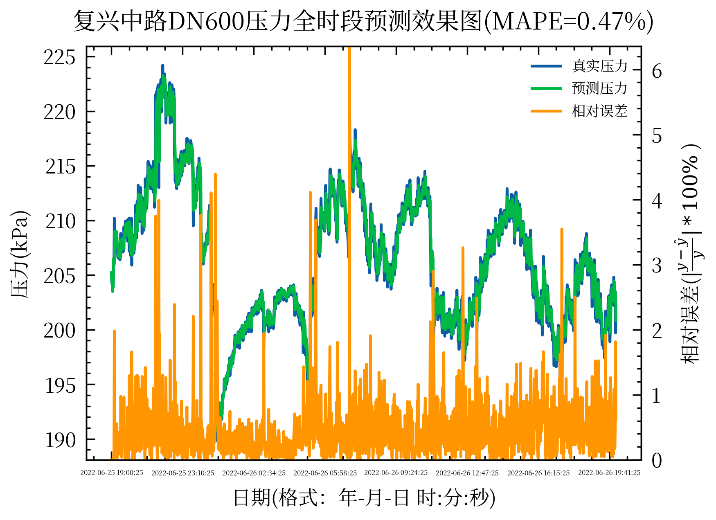
Urban water systems are observed through demand and pressure time series. Average prediction error does not show whether a model responds late to a change in demand, or whether it misses pressure variation caused by an unmeasured disturbance. The two studies below isolate these two errors.

Demand dynamics near turning points

Daily urban water demand is nonlinear and nonstationary. The knowledge-based bi-correction model addresses forecast lag near turning points, where the predicted response follows a change in demand too late. Lag-penalty attention weights the sequence and feature information that marks a timely change. A stacked LSTM produces the forecast, and a masked weighted Markov chain corrects selected residuals from the posterior error.

Evaluation of response timing

The study introduces mean prediction trend effectiveness, which tests whether the predicted trend improves on a naive forecast. Reported next to the absolute-error metrics, it separates delayed response near a turning point from error in the demand magnitude.

Pressure response under unmeasured disturbances

CritiCoder models macroscopic pressure when the measured variables do not explain every disturbance in a water distribution system. The Coder learns the pressure response to the observed variables. The Critic, trained with a different loss, represents the remaining variation as a distribution over the unmeasured disturbances.

Evaluation of disturbance sensitivity

The node-level comparison covers pressure monitors with different disturbance strengths. At the nodes most affected by unmeasured disturbances, CritiCoder loses less predictive accuracy than the regression baselines.

Relation to physical intelligence

The two studies measure two properties of the state that later scheduling or control will use. KbBcM tests whether a sequence model follows a change in demand at the right time. CritiCoder tests how pressure prediction behaves when the measured inputs leave part of the variation unexplained. Both belong to directions A and B, and both are evaluated using errors that would affect subsequent decisions.

Publications

Shunyu Wu, Jingcheng Wang, Haotian Xu, Shangwei Zhao, and Jiahui Xu. Knowledge-based Bi-correction model for achieving effective lag-free characteristic on daily urban water demand forecasting. Expert Systems with Applications, 255, 124508, 2024.

Shunyu Wu, Jingcheng Wang, Haotian Xu, Shangwei Zhao, and Jiahui Xu. CritiCoder: An End-to-End Uncertain Regression Network for Robust Macroscopic Pressure Models in Water Distribution Systems. IEEE Transactions on Computational Social Systems, 11(2), 2222-2233, 2024.